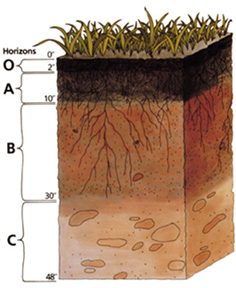
Healthy soil is not a passive growing medium. It is a living system. In a single handful of well-managed garden soil from Ontario or British Columbia, the total number of microorganisms routinely exceeds the number of people on Earth. These organisms — bacteria, fungi, nematodes, protozoa, and arthropods — run every major nutrient cycle that sustains plant growth. Understanding what they need, and what disrupts them, is the foundation of regenerative land care for any plot size.
The Main Players in Soil Biology
Bacteria
Bacteria are numerically dominant in most Canadian soils, with populations ranging from one to ten billion cells per gram of topsoil in productive systems. They decompose simple sugars and proteins rapidly, releasing ammonium, phosphate, and sulphate as byproducts. Nitrogen-fixing genera such as Rhizobium and Azospirillum convert atmospheric nitrogen into plant-available ammonia — a process that, at the field scale, can supply 30 to 200 kg of nitrogen per hectare per year without synthetic inputs.
Bacteria thrive in moist conditions with adequate oxygen. Compaction and waterlogging shift populations toward anaerobic species that produce organic acids and methane, reducing soil pH and suppressing beneficial activity. In Canadian prairie soils tested by Agriculture and Agri-Food Canada, bacterial biomass in no-till plots was 18 to 45 percent higher than in corresponding tilled plots after five years.
Fungi
Fungal hyphae extend through soil at rates of up to one centimetre per hour under optimal conditions. Mycorrhizal fungi form symbiotic associations with the roots of approximately 80 percent of terrestrial plant species, extending the effective root zone by orders of magnitude. In exchange for plant-derived carbon, they transfer phosphorus — an element with low soil mobility — directly to root cells.
Saprophytic fungi break down lignin and cellulose, the structural compounds in woody plant material that bacteria cannot efficiently decompose. Without adequate fungal activity, carbon accumulates in slowly decomposing residues rather than being incorporated into stable humus fractions.
Nematodes and Protozoa
Bacterial-feeding nematodes and protozoa act as regulators. By consuming bacteria, they release nitrogen locked inside bacterial cells into plant-available forms — a pathway sometimes called the microbial loop. Research from the University of Guelph's Ontario Agricultural College documented that plots with diverse nematode communities required 15 to 20 percent less supplemental nitrogen than adjacent plots with suppressed nematode populations.

Organic Matter: The Foundational Input
Soil organic matter — measured as a percentage of dry soil weight — is the single most reliable indicator of biological activity. In the Canadian prairies, native grassland soils historically held 8 to 12 percent organic matter. Decades of tillage reduced many of these soils to 2 to 4 percent. At levels below 2 percent, aggregation breaks down, water-holding capacity drops sharply, and microbial communities become dominated by stress-tolerant generalists rather than the specialised decomposers and nitrogen-fixers associated with fertile systems.
Building Organic Matter on Small Plots
- Compost at 5 to 10 cm depth annually. Surface applications of finished compost feed soil organisms without disturbing the structure they depend on.
- Maintain living roots year-round. Plant roots exude sugars and amino acids that directly feed mycorrhizal networks and bacterial communities. Bare soil between growing seasons is a lost opportunity.
- Minimise bare soil exposure. In a Canadian winter, frozen bare soil loses minimal biology. But in a warm autumn or early spring, bare soil can lose two to four times more carbon through microbial respiration than mulched soil.
- Avoid synthetic nitrogen at high rates. Nitrogen applications above roughly 150 kg/ha can reduce fungal diversity by favouring fast-cycling bacteria. This is not an argument against supplemental nitrogen, but for precision in timing and rate.
Soil Testing and Interpretation
Standard provincial soil tests — available through labs in each Canadian province — measure pH, available phosphorus (Bray P1 or Mehlich 3), potassium, calcium, magnesium, and sometimes organic matter percentage. These chemical snapshots do not directly measure biological activity, but they provide context for diagnosing problems.
Supplementary biological testing — available from laboratories such as federally accredited soil labs — can quantify active bacterial and fungal biomass, total nematode counts, and soil respiration rates. For small plots, soil respiration measured with a simple jar test (weighing CO₂ absorbed by a caustic solution over 24 hours) gives a rough index of biological activity without laboratory costs.
Interpreting pH for Biology
Most beneficial soil organisms operate optimally between pH 6.0 and 7.0. Below pH 5.5, aluminium and manganese become soluble and toxic to both plants and many bacteria. Mycorrhizal fungi are somewhat more acid-tolerant, but their host plants are usually not. In naturally acidic Canadian soils — common in Atlantic provinces and parts of the Boreal fringe — agricultural lime applications to raise pH above 6.0 consistently increase microbial biomass within two growing seasons.
Common Disruptions to Soil Biology
Several practices common in conventional Canadian horticulture reduce biological activity in ways that persist for multiple seasons:
- Rototilling to depth. Passes deeper than 8 cm fragment mycorrhizal hyphal networks and invert soil layers, bringing anaerobic subsoil organisms to the surface while burying aerobic topsoil communities.
- Fumigation. Broad-spectrum soil fumigants eliminate pathogens but also eliminate the beneficial communities that compete with pathogens. Re-inoculation with compost or mycorrhizal products is necessary after any fumigation event.
- Persistent herbicides. Some herbicides with soil residual activity affect microbial enzyme production. Glyphosate, while rapidly degraded in most mineral soils, chelates manganese and other micronutrients used by soil organisms.
- Irrigation with chlorinated municipal water. Chlorine and chloramines in municipal water supplies reduce bacterial populations in the top 5 cm of irrigated soil. Allowing water to off-gas in an open tank for 24 hours before drip irrigation eliminates most of this effect.
Practical Steps for the Coming Season
For a garden plot of any size in Canada, three actions deliver consistent biological improvements across all growing regions and soil types:
- Apply 5 cm of finished compost to all beds in autumn or early spring, before any soil work.
- Seed a winter cover crop — annual ryegrass or hairy vetch in most provinces — immediately after the main harvest.
- Stop tilling below 5 cm. Surface cultivation to manage weeds is fine. Deep tillage rarely delivers the benefits it promises and consistently reduces biological activity for 12 to 18 months.

